
The GG Project
About
The Promise of Esports
The topic of mental health in esports has received increasing attention in recent years, for a variety of reasons. On the one hand, playing at a high-level often involves an intense practice schedule and long competitive calendar, with recent reports highlighting just how taxing this can be. On the other hand, gaming and esports can be an incredible vehicle to reach a young and global audience to promote health and well-being.


Report on esports and video games, European Parliament
“…video games and esports can provide significant mental health benefits for many players and have the capacity to disseminate positive values, which should be pursued for the younger audience in particular”
The Good Game Project Consortium
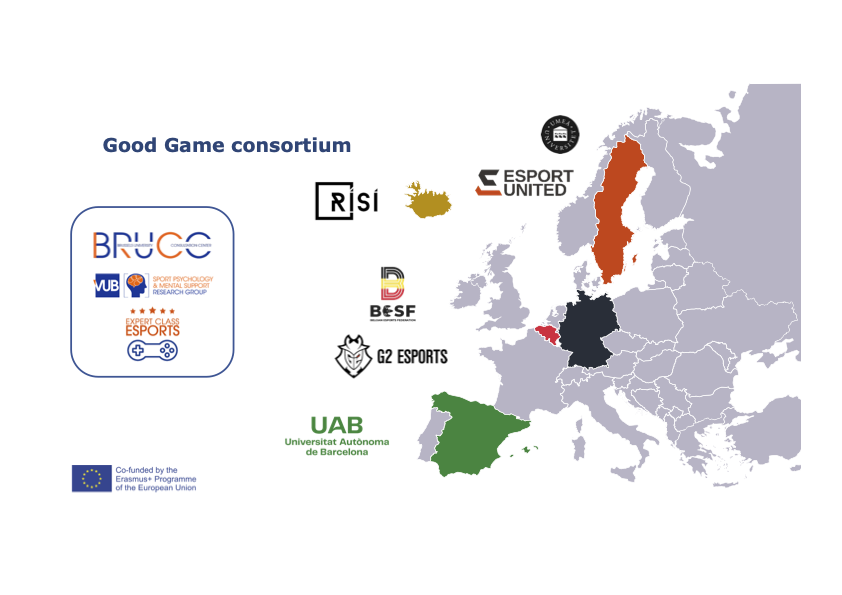
In light of the above, a consortium of organisations from across Europe have teamed up to launch the Good Game Project. Led by the Vrije Universiteit Brussel, the project is funded by a three-year grant from Erasmus+ (the European Union’s programme to support education, youth and sport in Europe) and involves a range of academic and industry partners across five European countries:
- Vrije Universiteit Brussel
- G2 Esports
- Belgian Esports Federation
- Esport United
- Icelandic Esports Association
- Universitat Autònoma de Barcelona
- Umeå University
The GG Project aims to provide as much real-world impact as possible, implementing a range of strategies to promote and enhance mental health in esports. A key initial step in the project will be collecting insights from players and other stakeholders in order to establish a strong evidence base for the later work. This research will then form the foundation for the development of multifaceted resources relating to topics such as mental health literacy, psychological skills and sleep. Recognising the crucial role that players’ broader support networks play in their mental health, the GG Project will further develop resources for coaches and parents.
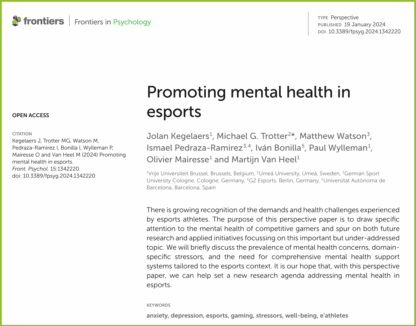
The GG Project has already produced a scientific paper that outlines the current lay of the land around mental health in esports and directions for future work.
Key References:
- Kegelaers, J., Trotter, M. G., Watson, M., Pedraza Ramirez, I. A., Bonilla, I., Wylleman, P., Mairesse, O., & Van Heel, M. (2024). Promoting mental health in esports. Frontiers in Psychology, 15, 1342220.
- Sankey, C., Wallace, L., & Caperchione, C. M. (2023). Understanding the role of coaches in supporting the mental health of elite athletes. Journal of science and medicine in sport, 26(8), 399-404.
- Watson, M., Smith, D., Fenton, J., Pedraza-Ramirez, I., Laborde, S., & Cronin, C. (2022). Introducing esports coaching to sport coaching (not as sport coaching). Sports Coaching Review, 1-20.
Matthew Watson, a member of the consortium and specialist in esports coaching, highlighted one of the key aspects of the project:
“I’m delighted to see the GG Project get underway, not least because of the potential to help coaches in their efforts to support players. Coaches in sport and esport can be influential in the lives of players, yet research suggests that coaches could use greater support when it comes to mental health. For example, in a study of 17 elite-level swimming coaches, Sankey and colleagues (2023) reported that coaches felt a lack of training opportunities limited their mental health literacy and ability to handle more complex cases. Other research, including in esports, suggests that coaches would further benefit from greater support for their own mental health, which will also be considered within the GG Project.”
With the support of the Erasmus+ grant and European-wide group of academic and industry partners, the GG Project is a great step forward for esports and will add momentum to the growing awareness of this crucial topic.
Stay tuned for more information and project updates. GG!